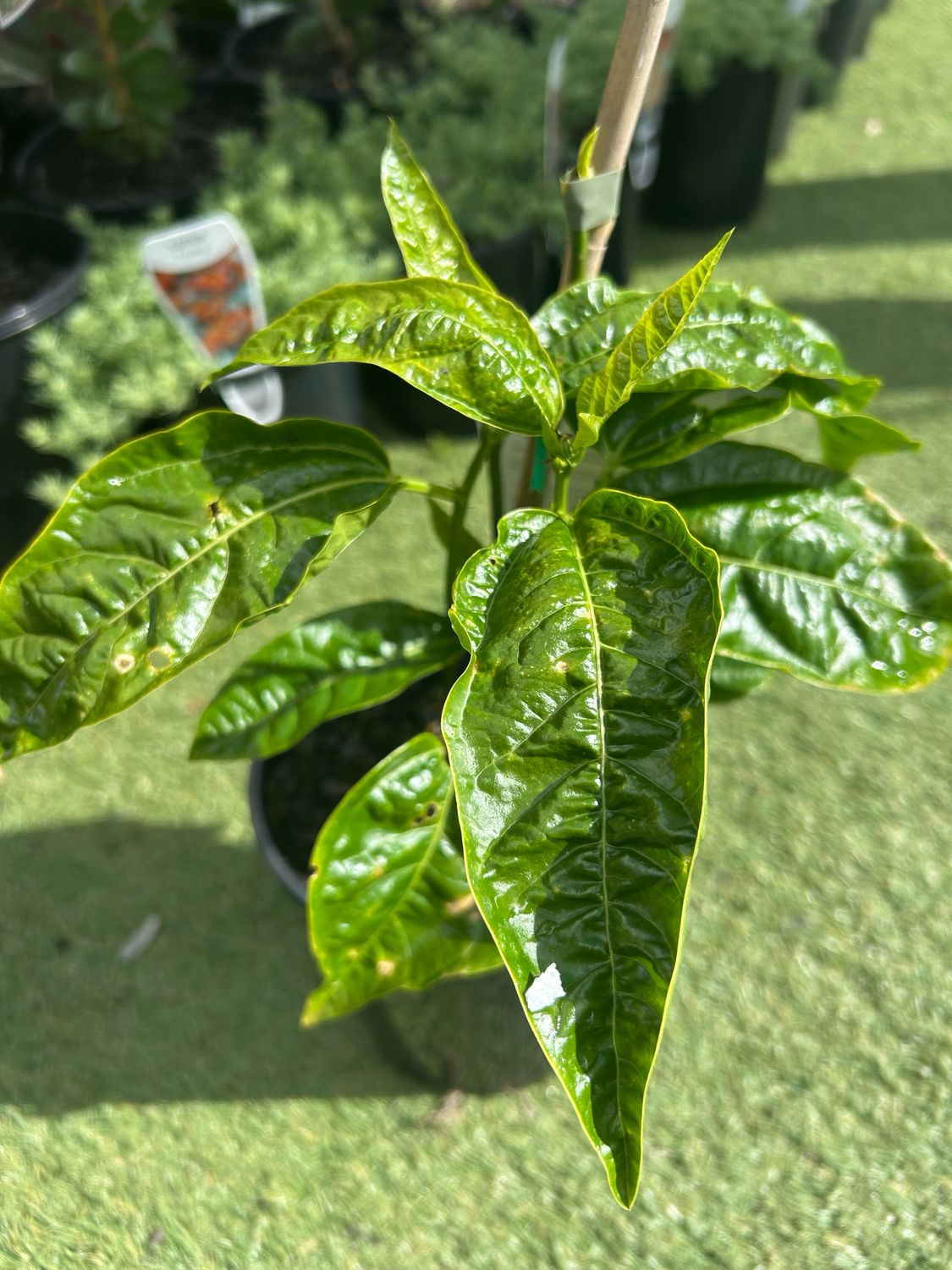
Passion Fruit Flame Ruby
AU$18.00
Special
was AU$22.00 Save 18%
Price incl. GST (10%) AU$1.64
In stock: 1 available
Product Details
Passionfruit ‘Flame Ruby’ is a vigorous, evergreen climbing passionfruit that produces large, deep-purple, freckled fruits filled with juicy golden-orange pulp. It is an excellent choice for Perth gardens when planted in a warm, sunny and sheltered position.
⭐ Main features
- Botanical name: Passiflora edulis ‘Flame Ruby’
- Type: Evergreen fruiting vine
- Growth: Fast-growing and vigorous climber
- Height: Approximately 2–4 m, depending on support
- Spread: Around 2–3 m when trained on a trellis
- Fruit: Large, deep purple and freckled
- Pulp: Juicy golden/orange pulp with crunchy seeds
- Flowers: Attractive ornamental passionfruit flowers
- Pollination: Generally self-fertile; good bee activity and/or hand pollination can improve fruit set
- Fruit production: Can begin cropping within about 9–12 months under good conditions, although full production may take longer.
- Uses: Fresh eating, desserts, drinks, smoothies, jams and sauces
- Landscape use: Excellent for pergolas, fences, screens and trellises.
😋 Taste of Flame Ruby
The fruit has a sweet, aromatic and pleasantly tangy passionfruit flavour. The golden-orange pulp is juicy and contains crunchy edible seeds.
The fruit is best allowed to fully colour and ripen on the vine. Fully ripe fruit may naturally fall from the vine.
🌞 Growing Passionfruit Flame Ruby in Perth
Perth’s climate can be very good for passionfruit, but summer heat, dry sandy soils and winter cold need to be managed.
Best position
Choose:
- Full sun — ideally 6+ hours of sunlight
- A warm, sheltered position
- Protection from strong winds
- A strong trellis, fence or pergola
- Well-drained soil
Avoid areas where water sits around the roots. Passionfruit dislikes poorly drained, constantly wet soil.
For Perth, I would particularly recommend a north or north-west facing protected position where possible.
🌱 Planting method
In the ground
- Choose a sunny location beside a strong trellis.
- Improve Perth sandy soil with good-quality compost and organic matter.
- Dig a hole approximately twice the width of the nursery pot.
- Plant at approximately the same depth as it was growing in the pot.
- Water deeply after planting.
- Apply a 5–8 cm layer of organic mulch, keeping mulch away from the stem.
- Train the main vine vertically until it reaches the top of the support.
- Once it reaches the top, guide the vine horizontally.
Important: Passionfruit develops an extensive root system, so don’t concentrate all your water and fertiliser immediately around the trunk.
Growing in a pot
Flame Ruby can be grown in a large container, but use a large pot with excellent drainage and a strong trellis.
A pot around 50 L or larger is preferable for long-term production.
💧 Watering in Perth
This is one of the most important parts of growing passionfruit successfully.
Summer
During hot Perth weather:
- Water deeply and regularly.
- Newly planted vines may need watering daily or every 1–2 days, depending on soil and temperature.
- Established vines need consistent moisture, particularly during flowering and fruit development.
Don’t allow the soil to repeatedly become bone dry and then suddenly become saturated. Dry conditions can contribute to poor fruit development and fruit drop.
Winter
Reduce watering considerably according to rainfall and soil moisture.
The biggest mistake in Perth winter is keeping passionfruit roots constantly wet.
🌿 Fertiliser management
Flame Ruby is a vigorous and hungry fruiting vine, but don’t overfeed it with high-nitrogen fertiliser.
Too much nitrogen can produce lots of leaves and shoots but fewer flowers and fruits.
Recommended Perth feeding program
Late winter / early spring
- Apply compost or well-aged organic matter.
- Apply a balanced fruit-tree/passionfruit fertiliser.
Spring–summer
- Feed during active growth according to the fertiliser label.
- A fruiting fertiliser containing adequate potassium is useful for flowering and fruit development.
Flowering and fruiting
- A fertiliser containing potassium can support flowering and fruit production.
- Avoid excessive nitrogen.
Gardening Australia also recommends a general organic fertiliser for growth and potash or fruit-tree fertiliser to support flowering and fruit set.
Tip: Always water well after applying granular fertiliser.
✂️ Pruning & training
Pruning is particularly important because Flame Ruby is a vigorous vine.
First year
Train one strong main stem upwards.
When it reaches the top of the trellis:
Pinch the growing tip to encourage side shoots.
Train these side shoots horizontally along the support.
These lateral branches will produce the productive growth.
Established vine
Passionfruit flowers and fruits on new-season growth, so regular renewal pruning is important.
In Perth, late winter to early spring is a good time for the main structural prune.
Remove:
- Dead wood
- Weak branches
- Tangled growth
- Very old unproductive wood
- Excessively crowded shoots
Reduce old growth by around one-third or more where necessary, while retaining healthy productive framework.
Keep the vine open enough for sunlight and airflow.
🐝 Improving fruit production
Although Flame Ruby is generally described as self-fertile, good pollination is still important.
To improve fruit set:
- Encourage bees and other pollinators.
- Avoid spraying insecticides when flowers are open.
- Keep excessive foliage from hiding flowers.
- If fruit set is poor, hand-pollination with a small brush can help.
Hand pollination can be particularly useful when there isn’t much bee activity around the garden.
🐛 Common problems
Poor flowering
Possible causes:
- Too much nitrogen
- Insufficient sunlight
- Excessive pruning at the wrong time
- Young plant
- Nutritional imbalance
Flowers but no fruit
Possible causes:
- Poor pollination
- Lack of bees
- Extreme heat/wind
- Water stress
Fruit dropping prematurely
Keep moisture consistent and avoid severe drying out. Poor pollination and weather stress can also contribute.
Yellow leaves
Check:
- Waterlogging
- Poor drainage
- Nutrient deficiency
- Root problems
Vine suddenly declining
Passionfruit vines naturally have a relatively short productive lifespan. Many vines perform strongly for around 3–5 years, after which production can decline substantially.
For a home garden, it’s smart to plant a replacement vine before the old one reaches the end of its productive life.
🏡 Landscaping importance
Flame Ruby is more than just a fruit plant.
It can provide:
🌿 Fast-growing privacy screening
🌿 Cover for fences and pergolas
🌿 Attractive flowers
🌿 Edible fruit
🌿 Excellent vertical use of garden space
🌿 A productive feature plant for small gardens
It is particularly attractive when trained across a pergola or large horizontal trellis, where the foliage provides screening while the fruit hangs through the canopy.
Save this product for later
Customer reviews
Reviews only from verified customers
No reviews yet. You can buy this product and be the first to leave a review.
Passion Fruit Flame Ruby
Display prices in:AUD